As of 09/17/2025
Indus: 46,018 +260.42 +0.6%
Trans: 15,502 -145.76 -0.9%
Utils: 1,086 +2.00 +0.2%
Nasdaq: 22,261 -72.63 -0.3%
S&P 500: 6,600 -6.41 -0.1%
|
YTD
+8.2%
-2.5%
+10.5%
+15.3%
+12.2%
|
 46,700 46,700 or 44,700 by 10/01/2025
16,700 or 15,200 by 10/01/2025
1,150 or 1,050 by 10/01/2025
22,700 or 21,400 by 10/01/2025
6,750 or 6,400 by 10/01/2025
|
|
As of 09/17/2025
Indus: 46,018 +260.42 +0.6%
Trans: 15,502 -145.76 -0.9%
Utils: 1,086 +2.00 +0.2%
Nasdaq: 22,261 -72.63 -0.3%
S&P 500: 6,600 -6.41 -0.1%
|
YTD
+8.2%
-2.5%
+10.5%
+15.3%
+12.2%
|
46,700 or 44,700 by 10/01/2025
16,700 or 15,200 by 10/01/2025
1,150 or 1,050 by 10/01/2025
22,700 or 21,400 by 10/01/2025
6,750 or 6,400 by 10/01/2025
|
|
Bulkowski on Ugly Double Bottoms
Statistics updated and 10 examples added: 8/20/25.
Ugly Double Bottoms: Summary
Think of an ugly double bottom as a double bottom in which the second bottom is significantly higher than the first. Ugly double bottoms can help you time the entry when bottom fishing.
The average rise is slightly better than for all double bottoms (41% for ugly double bottoms versus 37% regular double bottoms) but the failure rate is about the same, 15% (ugly double bottoms) versus 16% for
all double bottoms. The following statistics are based on a study of 4,376 patterns found in 1,326 stocks from July 1991 to July 2025. Discovered by Thomas N. Bulkowski in March 2006.
$ $ $
My book, Encyclopedia of Chart Patterns, 3rd Edition takes an in-depth look at 76 charts, including performance statistics. However,
it does not include ugly double bottoms. I wonder why I left it out...
If you click on the above link and then buy the book (or anything) while at Amazon.com, the referral will help support this site. Thanks.
-- Tom Bulkowski
$ $ $
|
|

Ugly Double Bottom Chart Pattern
|
Ugly Double Bottoms: Important Bull Market Results
Overall rank for up breakouts: 23 out of 41
Break even failure rate: 15%
Average rise: 41%
Throwback rate: 64%
Percentage meeting price target: 63%
The above numbers are based on 4,376 perfect trades. See the glossary for definitions.
Ugly Double Bottoms: Identification Guidelines
| Characteristic | Discussion |
| Price trend | The inbound primary (long term) trend direction, when up, gives slightly better performance. |
| Shape | Looks like a double bottom with unequal bottoms. The second bottom should be between 5% and 15% higher than the first, and a consecutive minor low (no intervening low). |
| Volume | Recedes 80% of the time |
| Breakout | Upward when price closes above the highest high between the two bottoms. |
| Confirmation | The pattern confirms as valid when price closes above the peak between the two bottoms. If price does not close above the confirmation price then it's not an ugly double bottom. |

As an example, consider the figure to the right. Points 1 and 2 show the two bottoms after a price downtrend. The pattern becomes a true ugly double
bottom when price closes above the horizontal blue line (the word Buy points to it in the figure).
You may think that points A and B also form an ugly double bottom, but they do not. Price does not close above C (the highest
high between the two bottoms, shown as the green line) before making a new low at D. That is a very important distinction.
Price must rise above the highest high between the two bottoms to confirm the ugly double bottom as a valid chart pattern. Otherwise, you just have more squiggles on the price chart.
 More (#ad)
Ugly Double Bottoms: Trading Tips
| Trading Tactic | Explanation |
 The Measure Rule
|
| Measure rule | Compute the height from the highest peak (point C in the Measure Rule figure to the right) to
the left bottom low (A) then multiply it by the above 'percentage meeting price target.' Add the difference
to the breakout price (the price of the highest high between the two bottoms, C) to get a price target. |
| Second Low | The second bottom (the right one, B, in the Measure Rule figure to the right)
should be at least 5% above the left one (A). |
| Trend | The best performance comes from short-term (0-3 months) trends leading to the chart pattern. |
| Reversal | The pattern acts as a reversal of the downtrend. |
| Volume trend | If volume slopes upward (between the two bottoms), the pattern tends to perform better. |
| Avoid yearly low | Patterns with breakouts within a third of the yearly low tend to under perform. |
To improve performance, look for patterns with breakout day volume above the 30-day average (heavy breakout volume).
More (#ad)
Ugly Double Bottoms: Trading Setup

The figure to the right shows the preferred setup. The decline begins at point 1, usually several months before the ugly double bottom.
As price nears the ugly double bottom, it declines at a faster rate, usually forming a straight-line run that approximates 45 to 60
degrees (points 2 to 3). This is the blow-off stage and it usually lasts at least a month, often 6 weeks or so. The
panic selling ends at 3 and a bounce occurs which takes price back up to 4, forming the second bottom of an unconfirmed
ugly double bottom.
After point 4, it should take several days (11 is the average) for an upward breakout to occur in a strong
push upward on high volume. Price usually continues in a strong advance upward. If you see price rounding over and
closing below a trendline formed by joining points 3 and 4 and projected upward (the green sell line, but only if the line is shallow (say, 30 degrees or less)), then consider
selling. Unless the trendline is unusually steep, a close below the trendline means the primary decline has work left
to do and price is going lower. Save your bucks and sell immediately. Otherwise, watch the rise and monitor the 3-4
trendline. Many times, price will break this trendline several months later when the rise ends. That's the time to sell.
More (#ad)
Ugly Double Bottoms: Example

The above figure shows an example of an ugly double bottom chart pattern. Price moves nearly horizontally during
October and into November and then takes a dive to the first low at 1. A higher low occurs at 2, forming the ugly double bottom, confirmed when price closes above the
blue confirmation line. A throwback occurs but it does not close below a line connecting bottoms 1 and 2.
More (#ad)
Other Ugly Double Bottom Examples
Ugly Double Bottoms: Trading Lessons
I present the information in slider format, so be sure to click the left or right arrows to view another slide.
Lessons Summary
- Slide 1. Gap down serves as a warning not to trade.
- Slide 2. Avoid multi-peak resistance.
- Slide 3. Buy signal: tall spike.
- Slide 4. Another multi-peak disaster.
1 / 4

This chart shows the stock gapping downward (at A) before the ugly double bottom forms. Should you take the trade? My answer was "no." Why? Because of the gap down. That happened on bad news (I'm assuming.
I didn't check but the market reacted to it by dropping). The stock recovered over the next three months before gapping down again. Because the spread was 3 months between the two gaps, the gaps could be due to
a bad earnings surprise. The stock never made it to the measure rule target before failing.
Next chart please.
2 / 4

This is a trade I didn't take because of the multi-peak pattern. I underlined the peak in red (it's a head-and-shoulders top, too). The bottom of this pattern looks formidable from a resistance
perspective. As the chart shows, the stock moved up and reached the ultimate high (green dot) but fell short of the measure rule sell target. The stock eventually cratered for a loss.
Next chart please.
3 / 4

This is a chart which shows a long tail (or spike, as it's called, circled). In this case, the downward plunge is bullish because the bulls drive price back up to close near the
top of the day's price range. It suggests bulls will remain in command. And they do, resulting in a winning trade.
Next chart please.
4 / 4

This is another example of a multi-peak disaster. I circled the multi-peak in red but resistance to an upward move extends to the right as the horizontal red line shows. The stock hits that
resistance and tumbles to form the ugly double bottom. The stock climbs to the ultimate high (green dot) and then sinks. It does not reach the measure rule target.
The end.
❮
❯
More (#ad)
Ugly Double Bottoms: 10 Examples
The following is a slide show. Click the right or left arrows, or the circles below the chart to navigate around the slides.
1 / 10
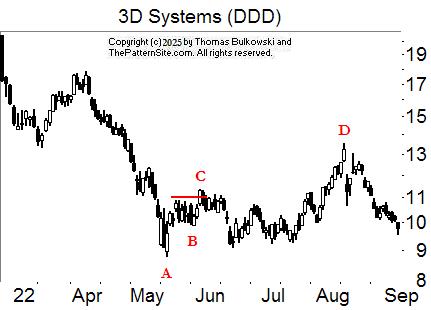
AB is the ugly double bottom. C is confirmation where the squiggles turn into a valid chart pattern. D is the ultimate high, the highest price reached before the stock drops by at least 20%.
The next chart gives another example.
2 / 10

AB is the ugly double bottom.
The next chart gives another example.
3 / 10

AB is the ugly double bottom. To the left of C is the ultimate high.
The next chart gives another example.
4 / 10

AB is the ugly double bottom. This ugly pattern happened in an upward, so the chart pattern acted as a continuation and not a reversal.
The next chart gives another example.
5 / 10

AB is the ugly double bottom. C is the ultimate high.
The next chart gives another example.
6 / 10

AB is the ugly double bottom. Connecting AB with a trendline as a sell signal, depending on how accurately you draw it, would have signaled a sell near C.
The next chart gives another example.
7 / 10

AB is the ugly double bottom.
The next chart gives another example.
8 / 10

AB is the ugly double bottom.
The next chart gives another example.
9 / 10

AB is the ugly double bottom. D is a throwback. C is the ultimate high.
The next chart gives another example.
10 / 10

AB is the ugly double bottom.
The End.
❮
❯
-- Thomas Bulkowski
More (#ad)
See Also
Support this site! Clicking any of the books (below) takes you to
Amazon.com If you buy ANYTHING while there, they pay for the referral.
Legal notice for paid links: "As an Amazon Associate I earn from qualifying purchases."
|
My Stock Market Books
|
My Novels
|
Copyright © 2005-2025 by Thomas N. Bulkowski. All rights reserved.
Disclaimer: You alone are responsible for your investment decisions. See
Privacy/Disclaimer for more information.
Some pattern names are registered trademarks of their respective owners.
Lottery: a tax on people who are bad at math.
 on
on 